
Clavicular: Meaning, Anatomy, Fractures, and Clinical Significance Explained
A comprehensive guide to clavicular anatomy, fractures, muscles, joints, breathing patterns, and lymph nodes — everything you need to know about the collarbone and its clinical significance.
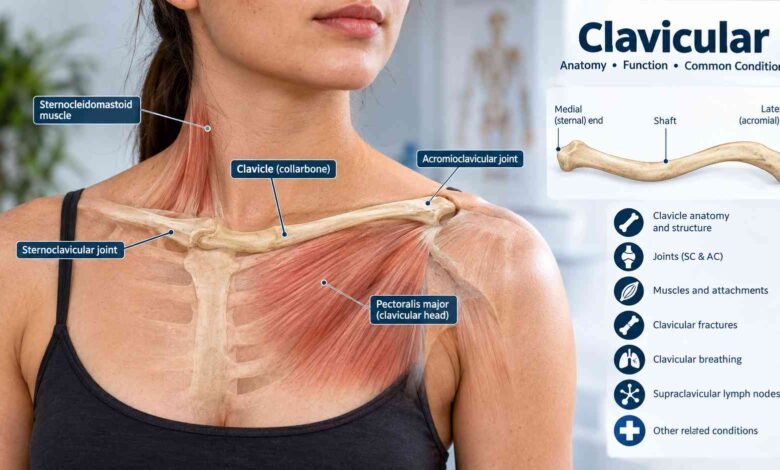
The term clavicular refers to anything related to the clavicle, commonly known as the collarbone. This slender, S-shaped bone plays a critical role in connecting your arm to your torso and enabling a wide range of shoulder movements. Whether you’ve encountered “clavicular” in a medical report, anatomy textbook, or fitness context, understanding this term opens the door to deeper knowledge about shoulder health, injury prevention, and human movement.dictionary.cambridge+3
This guide covers everything you need to know about clavicular anatomy, common injuries like fractures, associated muscles and joints, and even specialized topics like clavicular breathing and lymph nodes. By the end, you’ll have a clear, practical understanding of why this small bone matters so much to your upper body function.
What Does Clavicular Mean?
Clavicular is a medical and anatomical adjective describing structures, conditions, or functions related to the clavicle. The clavicle itself is a long, horizontally oriented bone that runs between the sternum (breastbone) and the scapula (shoulder blade).dictionary.cambridge+3
In everyday language, you might hear terms like:
-
Clavicular fracture — a broken collarbone
-
Clavicular head — the portion of a muscle attaching to the clavicle
-
Sternoclavicular joint — where the clavicle meets the sternum
-
Acromioclavicular joint — where the clavicle meets the shoulder blade
Understanding these terms helps when discussing shoulder injuries, reading medical reports, or studying human anatomy.teachmeanatomy+1
Clavicle Anatomy: Structure and Function
The clavicle is unique among bones in the human body. It is the only long bone that lies horizontally rather than vertically. Here’s what makes it special:radiopaedia+1
Basic Structure
-
Length: Approximately 6 inches (15 centimeters) in adultsclevelandclinic+1
-
Shape: Sigmoid or S-shaped with two curvesncbi.nlm.nih+1
-
Position: Runs horizontally across the top of the chest, just below the neckclevelandclinic
-
Classification: A long bone, despite its slender appearanceelsevier+1
Three Main Parts
The clavicle is divided into three anatomical regions:
-
Medial (Sternal) End — The thicker, inner end that connects to the manubrium of the sternum, forming the sternoclavicular joint.teachmeanatomy+1
-
Shaft — The middle portion, which is the most common site for fractures due to its relatively narrow structure.ncbi.nlm.nih+1
-
Lateral (Acromial) End — The flatter, outer end that articulates with the acromion process of the scapula, forming the acromioclavicular (AC) joint.teachmeanatomy+1
Key Functions
The clavicle serves several vital purposes:
-
Structural Support: Acts as a strut that keeps the shoulder blade in proper position during arm movement.clevelandclinic+1
-
Force Transmission: Transfers forces from the upper limb to the axial skeleton (the central skeleton including the spine and ribcage).ncbi.nlm.nih+1
-
Protection: Shields important neurovascular structures (nerves and blood vessels) that pass behind it toward the arm.ncbi.nlm.nih
-
Range of Motion: Enables substantial upper extremity function by stabilizing the shoulder girdle.ncbi.nlm.nih
Unique Development
The clavicle is the first bone to begin ossification (bone formation) during embryonic development, starting around the 5th to 6th week of fetal life. Interestingly, it is also the last bone to complete ossification, with the medial end not fully fusing until ages 24 to 26. This extended development timeline makes the clavicle important in forensic age estimation.ncbi.nlm.nih+2
Clavicular Joints: Where the Clavicle Connects
The clavicle forms two critical joints that enable shoulder mobility:
Sternoclavicular (SC) Joint
Located at the medial end, this joint connects the clavicle to the sternum. It is a synovial joint that allows multiple movements including elevation, depression, protraction, and retraction of the clavicle.hopkinsmedicine+2
Acromioclavicular (AC) Joint
Found at the lateral end, this joint links the clavicle to the acromion of the scapula. The AC joint is essential for overhead arm movements and is commonly injured in contact sports and falls.wikipedia+2
Both joints are stabilized by strong ligaments, including the coracoclavicular ligaments, which play a key role in fracture classification and treatment decisions.msdmanuals+1
Clavicular Fractures: Causes, Symptoms, and Treatment
Clavicle fractures, or broken collarbones, are among the most common orthopedic injuries. They account for up to 10% of all fractures and are especially frequent in children and young adults.ncbi.nlm.nih+1
Common Causes
-
Falls onto the shoulder or outstretched handaafp+1
-
Direct blows during contact sportsmsdmanuals+1
-
Motor vehicle accidentsbestpractice.bmj
-
Birth injuries in newbornsaafp
Symptoms
Typical signs of a clavicular fracture include:
-
Severe pain at the fracture sitehopkinsmedicine+1
-
Visible swelling or bruisinghopkinsmedicine
-
A noticeable bump or deformity over the claviclehopkinsmedicine+1
-
Difficulty moving the arm or shoulderhopkinsmedicine
-
Pain that worsens with arm movementhopkinsmedicine
Classification Systems
Medical professionals use several systems to classify clavicle fractures:
Allman Classification (most widely used):ncbi.nlm.nih+2
-
Group I: Middle third fractures (approximately 80% of cases)msdmanuals+1
-
Group II: Lateral (distal) third fractures (10–15% of cases)msdmanuals+1
-
Group III: Medial (proximal) third fractures (approximately 5% of cases)msdmanuals+1
Neer Classification further subdivides lateral fractures based on ligament involvement and displacement.ncbi.nlm.nih+1
Treatment Options
Non-Surgical Treatment (most common):
-
Arm immobilization using a sling or figure-of-8 bandagehopkinsmedicine+1
-
Ice therapy for 15–20 minutes every 2 hours to reduce swellinghopkinsmedicine
-
Pain medication such as acetaminophen or NSAIDshopkinsmedicine
-
Gradual physical therapy once healing beginsaafp
Surgical Treatment (for specific cases):
-
Open fractures requiring urgent interventionbestpractice.bmj
-
Significantly displaced or shortened fracturesaafp+1
-
Fractures with skin tenting or neurovascular compromiseemedicine.medscape
-
High-risk nonunion casesncbi.nlm.nih+1
Recovery Timeline
Most clavicular fractures heal within 6 to 12 weeks in adults, though children often heal faster. A prominent callus (healing bone) is common and may remain visible for months. Full return to sports or heavy activity typically takes 3 to 4 months.aafp+1
Clavicular Muscles: The Clavicular Head
Several important muscles attach to the clavicle, with the clavicular head of the pectoralis major being the most prominent.exerciselibrary+1
Pectoralis Major (Clavicular Head)
This upper portion of the chest muscle originates from the medial half of the anterior clavicle surface. Its key functions include:exerciselibrary+1
-
Arm flexion — lifting the arm forwardexerciselibrary
-
Horizontal adduction — bringing the arm across the bodyexerciselibrary
-
Internal rotation of the armexerciselibrary
The clavicular head is innervated by the lateral pectoral nerve (C5, C6) and receives blood supply from the pectoral branch of the thoracoacromial artery. Research suggests it may function as an independent muscle portion with its own tendon.exerciselibrary+1
Other Clavicular Attachments
Additional muscles connecting to the clavicle include:
-
Sternocleidomastoid — attaches to the medial end and helps elevate the clavicle during breathingpranadan
-
Trapezius — attaches to the lateral thirdkenhub
-
Deltoid — attaches along the lateral portionkenhub
-
Subclavius — runs beneath the clavicle, stabilizing itkenhub
Clavicular Breathing: Understanding the Pattern
Clavicular breathing (also called upper chest or high breathing) is a breathing pattern where the shoulders and collarbones rise noticeably during inhalation.voicescience+1
How It Works
During clavicular breathing:
-
The accessory muscles of inspiration (sternocleidomastoid and scalene muscles) contract prominentlyvoicescience+1
-
The upper ribs and sternum elevate, lifting the clavicles and shouldersvoicescience
-
Air is drawn mainly into the upper chest rather than the lower lungspranadan+1
When It Occurs
This breathing pattern is normal during:
-
Intense exercise or sprintingpranadan
-
Respiratory distressvoicescience
-
Certain singing styles in contemporary commercial musicvoicescience
Is It Healthy?
While useful in specific situations, clavicular breathing is the least efficient breathing pattern when used exclusively at rest. It utilizes only a small portion of lung capacity compared to diaphragmatic (belly) breathing. Chronic reliance on clavicular breathing may indicate underlying respiratory issues or poor breathing habits.pranadan+1
Clavicular Lymph Nodes: Clinical Significance
The supraclavicular lymph nodes are located just above the clavicle, near the sternoclavicular joint. These nodes are clinically important for several reasons:radiopaedia+1
Anatomy
-
Location: In the hollow superior to the clavicle, along the transverse cervical arteryelsevier+1
-
Number: Typically 4 to 12 nodes per sideelsevier+1
-
Boundaries: Bounded by the scalene muscles posteriorly and the sternocleidomastoid muscle anteriorlyncbi.nlm.nih+1
Medical Importance
Enlarged supraclavicular lymph nodes can signal serious conditions:
-
Virchow node — enlargement of the left supraclavicular node may indicate abdominal or thoracic cancer metastasis (known as Troisier sign)pmc.ncbi.nlm.nih
-
Infections of the head, neck, or upper limbselsevier
-
Lymphoma or other malignanciesradiopaedia
Because these nodes serve as a final common pathway for lymphatic drainage from much of the body, their enlargement warrants medical evaluation.radiopaedia
Infraclavicular Nodes
Smaller infraclavicular lymph nodes (1–2 nodes) lie in the deltopectoral groove between the deltoid and pectoralis major muscles. These drain the upper limb and shoulder region.seslhd.health.nsw.gov+1
Common Clavicular Conditions Beyond Fractures
While fractures dominate clavicular injuries, other conditions affect this region:
Sternoclavicular Joint Dislocation
Rare but serious, these dislocations can be anterior (more common, less dangerous) or posterior (potentially life-threatening due to nearby blood vessels and airways).musculoskeletalkey
Acromioclavicular Joint Separation
Common in contact sports, this injury involves ligament damage at the AC joint and is graded from Type I (mild sprain) to Type VI (severe displacement).musculoskeletalkey
Clavicular Osteomyelitis
Bone infection of the clavicle is uncommon but can occur after trauma, surgery, or in immunocompromised individuals.ncbi.nlm.nih
Congenital Clavicular Pseudarthrosis
A rare condition where the clavicle fails to fuse properly during development, resulting in a painless bump and shoulder droop.epos.myesr
When to See a Doctor
Seek immediate medical attention if you experience:
-
Severe shoulder or collarbone pain after traumahopkinsmedicine
-
Visible deformity or bump over the claviclehopkinsmedicine+1
-
Inability to move the arm or shoulderhopkinsmedicine
-
Numbness, tingling, or coldness in the arm (possible nerve or blood vessel damage)patient
-
Enlarged, painless lymph nodes above the claviclepmc.ncbi.nlm.nih+1
-
Difficulty breathing with prominent clavicular movementpranadan
Key Takeaways
-
The term clavicular describes anything related to the clavicle (collarbone).dictionary.cambridge+1
-
The clavicle is the only horizontally oriented long bone in the body and is essential for shoulder function.radiopaedia+1
-
Clavicle fractures are common, especially in young people, and usually heal well with conservative treatment.ncbi.nlm.nih+1
-
The clavicular head of the pectoralis major muscle enables arm flexion and horizontal adduction.exerciselibrary
-
Clavicular breathing uses accessory muscles and is inefficient for everyday breathing.voicescience+1
-
Supraclavicular lymph node enlargement can indicate serious underlying conditions and requires evaluation.pmc.ncbi.nlm.nih+1
FAQ
What does clavicular mean in medical terms?
Clavicular is an adjective meaning “related to the clavicle” (collarbone). It is used to describe anatomical structures, injuries, or conditions involving this bone, such as clavicular fractures or the clavicular head of a muscle.dictionary.cambridge+3
Where is the clavicular bone located?
The clavicle runs horizontally across the top of your chest, connecting the sternum (breastbone) in the center to the scapula (shoulder blade) on each side. You can feel it just below your neck on both sides.clevelandclinic+1
What is a clavicular fracture?
A clavicular fracture is a broken collarbone, typically caused by a fall onto the shoulder or outstretched hand. Symptoms include severe pain, swelling, and visible deformity at the fracture site. Most heal with a sling and rest, though some require surgery.ncbi.nlm.nih+4
What is the clavicular head of the pectoralis major?
The clavicular head is the upper portion of the pectoralis major muscle that originates from the medial half of the clavicle. It primarily flexes the arm at the shoulder and assists with horizontal adduction and internal rotation.exerciselibrary+1
What is clavicular breathing?
Clavicular breathing is a shallow breathing pattern where the shoulders and collarbones rise during inhalation due to activation of accessory respiratory muscles. While normal during intense exercise, it is inefficient for everyday breathing and may indicate respiratory issues if used chronically at rest.voicescience+2
Why are supraclavicular lymph nodes important?
Supraclavicular lymph nodes sit above the clavicle and drain lymph from the head, neck, chest, and abdomen. Enlargement, especially of the left node (Virchow node), can signal serious conditions like cancer metastasis and requires medical evaluation.pmc.ncbi.nlm.nih+2