
The Difference Between language and a language: A Simple Guide
A straightforward UK study guide explaining the exact difference between the biological concept of language and a language as a cultural system.
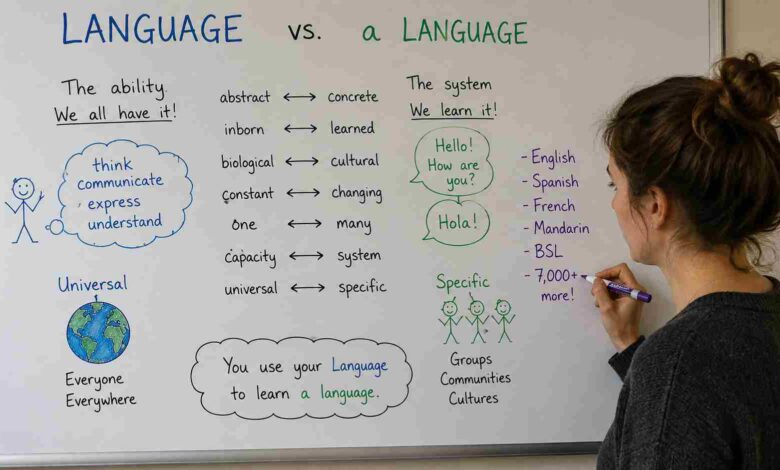
At first glance, asking about the difference between language and a language sounds like a trick question. However, if you are studying English or linguistics in the UK, understanding the contrast between language and a language is your first step to success. Teachers and examiners look for this exact knowledge in your essays. So, what exactly separates the two?
The main difference between language and a language is scope. Language (often written with a capital ‘L’) is the universal, biological ability that all humans share to communicate complex ideas. In contrast, a language refers to a specific, rule-based system of vocabulary and grammar used by a particular community, such as English, Welsh, or British Sign Language (BSL).
Key Takeaways
Before we look deeper at the separation of language and a language, here are the core points to remember:
-
Language is a human cognitive ability; a language is a specific cultural system.
-
You use your capacity for language to learn a language.
-
Linguists study “Language” to understand the human brain, while they study “a language” to map specific grammar rules.
-
There is only one human capacity for language, but there are over 7,000 distinct languages spoken globally.
-
Accents and dialects belong to “a language,” not the overarching concept of “Language.”
What is “Language”? (The Human Capacity)
When we discuss the divide between language and a language, the first part—Language—is about biology. Linguists are asking what makes human communication different from animal communication.
Humans have a unique physical and mental setup. Our brains are hardwired to recognize patterns, assign meanings to sounds, and structure those sounds into sentences. This universal capacity allows a baby born in London to learn English, while a baby born in Tokyo learns Japanese. The underlying biological hardware is exactly the same.
This general concept is entirely abstract. You cannot speak “Language.” You can only possess the ability for it.
What is “A Language”? (The Specific System)
To fully grasp the difference between language and a language, you must understand the second part. A specific language is a concrete system. It is the software running on the hardware of the human brain.
A specific language has its own distinct vocabulary (lexicon) and rules for putting words together (syntax). For example, French is a language. Urdu is a language. BSL is a language. Each of these systems developed historically within a specific social group.
They are tied to culture, geography, and history. Because of this, a language is constantly changing. New words are added, old words fade away, and pronunciation shifts over generations.
Core Differences: Language vs A Language
To make revision easy, here is a quick breakdown of how the concepts of language and a language compare side-by-side.
| Feature | Language (The Concept) | A Language (The System) |
| Definition | The universal human ability to communicate. | A specific system of words and rules. |
| Nature | Biological and cognitive. | Cultural and historical. |
| Quantity | Only one (the human faculty). | Over 7,000 worldwide. |
| Change | Evolves over millions of years. | Changes daily (new slang, shifted meanings). |
| Examples | The ability to process grammar. | English, Arabic, Mandarin, BSL. |
Why This Matters for A-Level English
If you are taking A-Level English Language with AQA, Edexcel, or OCR, mastering the concepts of language and a language is highly practical. Examiners want to see that you understand how human communication works on multiple levels.
Here is how you can apply your knowledge of language and a language directly to your coursework and exams:
-
Child Language Acquisition: When studying how children learn to speak, you will look at theories by researchers like Noam Chomsky. Chomsky argued that children are born with an innate capacity for Language, which allows them to quickly pick up the rules of a language.
-
Language Diversity: When writing about dialects and accents, you are analyzing variations within a language. Understanding the broader concept helps you explain why these variations are natural.
-
Sociolinguistics: You will explore how a language shapes identity. People use their specific language to signal where they are from and their social class.
For more detailed studies on how human communication impacts society, you can explore the University of Birmingham’s Department of English Language and Linguistics.
A Common Mistake: The Trap of Prescriptivism
One of the biggest mistakes people make when studying language and a language is confusing the rules of one with the capacity for the other. This leads to prescriptivism.
Prescriptivists believe there is a strict, “correct” way to speak a language, and any deviation is wrong. They might argue that using double negatives shows a lack of Language ability.
However, modern linguistics is descriptive. It looks at how people actually communicate. Linguists know that using slang or a regional dialect does not mean your brain’s capacity for Language is broken. You are simply using a different variation of a language. Every variation has its own logical rules, even if they differ from Standard English.
Wrapping Up and Your Next Steps
Understanding the line between language and a language transforms how you view human communication. You move from just looking at words on a page to seeing the incredible biological machinery behind them.
Here is what you should do next to solidify your knowledge of language and a language:
-
Review your syllabus to see exactly where “Child Language Acquisition” fits into your modules.
-
Create a flashcard separating the definitions of “Language” (biology) and “a language” (culture).
-
Start observing how people use different variations of a language in everyday life without judging them as “incorrect.”
FAQs
Why is it important to define these terms separately?
It is important to define language and a language differently because one refers to human biology, while the other refers to human culture. Blurring them leads to a poor understanding of linguistics.
Can an animal possess language?
Animals have complex communication systems, but they do not possess “Language.” Human Language features productivity (making endless new sentences) and displacement (talking about the past or future), which animal communication lacks.
Are dialects related to these concepts?
Yes, when discussing language and a language, dialects fall strictly under “a language.” For example, Geordie and Cockney are dialects of the English language. They share the same core system but have distinct regional variations.
What is Universal Grammar?
Universal Grammar is a theory proposed by Noam Chomsky. It suggests that the human brain contains an innate, biological blueprint for Language, making it easier for children to learn a specific language.
How does this distinction apply to sign language?
When looking at language and a language, British Sign Language (BSL) is recognized as a specific, fully formed language with its own grammar and vocabulary, powered by the universal human capacity for Language.