
Wendy Taylor (British Sculptor): Biography, Artworks, and Legacy
Wendy Taylor Biography: From East London to Grade II Listed Artworks
Are you researching the life and public works of Wendy Taylor? When you walk through London, you will likely pass by some of the most striking public art in the country without realising who made it. This artist changed how the UK interacts with modern sculpture.
Wendy Taylor CBE is a pioneering British sculptor born in 1945. She is famous for taking art out of galleries and placing it directly into public spaces. Her site-specific works, such as the Grade II listed Timepiece at St Katharine Docks, focus on themes of balance, illusion, and gravity.
Key Takeaways
-
She was born in Stamford in 1945 but grew up in Bow, East London.
-
She studied at the famous St Martin’s School of Art during the 1960s.
-
She shifted focus from gallery exhibitions to permanent public commissions early in her career.
-
Three of her sculptures in the UK currently hold Grade II listed status.
-
She received a CBE in 1988 for her massive contributions to British art.
Early Life and Education in London
Wendy Taylor was born in Stamford in 1945, but her roots are firmly planted in the East End of London, specifically Bow. Growing up in this working-class area deeply influenced her practical approach to creating art. She attended the prestigious St Martin’s School of Art from 1963 to 1967. During this time, she honed her skills in metalwork and engineering.
Unlike many of her peers who chased wealthy gallery buyers, she wanted everyday people to experience her work. This desire led her to focus heavily on how structures interact with their physical environment. She quickly earned a reputation for combining industrial materials with delicate visual balance.
Taking British Art Onto the Streets
In the 1970s, the UK art scene was heavily confined to elite galleries. Wendy Taylor became one of the very first artists of her generation to actively reject this model. She firmly believed that art should act as a direct method of communication with the public.
To achieve this, she turned her attention to site-specific commissions. This means she did not just make a statue and find a place for it later. Instead, she designed every piece specifically for the architecture, history, and community of its final location. Her work often challenges expectations by making heavy industrial materials like steel and brick appear to float or defy gravity.
The Engineering Behind the Illusion
People often assume that large-scale public art is simply built in a studio and dropped into a town square. This is a massive misconception, especially regarding the work of Wendy Taylor.
Her pieces require intense structural engineering and urban planning. She even served as a Design Consultant for the Basildon Development Corporation, proving that her work is as much about urban regeneration as it is about visual appeal. She engineers her sculptures to withstand decades of harsh UK weather while maintaining the illusion of weightlessness.
Most Famous Works by Wendy Taylor
With over 70 large-scale public sculptures across the world, narrowing down her best work is difficult. However, a few key installations stand out in the UK.
Here is a guide to her most celebrated Grade II listed artworks:
| Sculpture Name | Location | Year Installed | Visual Features |
| Timepiece | St Katharine Docks, London | 1973 | A massive steel sundial suspended by three heavy chains. |
| Octo | Central Milton Keynes | 1982 | A looping, figure-eight stainless steel structure over a pool. |
| Virginia Quay Settlers Monument | Jamestown Way, London | 1999 (Restored) | A historic monument marking the departure of the Virginia settlers. |
The Magic of Timepiece at St Katharine Docks
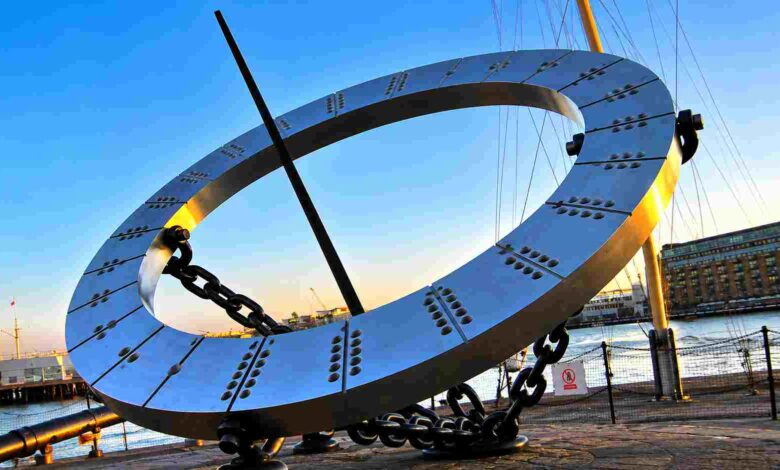
If you visit St Katharine Docks in London, you cannot miss Timepiece. Installed in 1973, this is arguably the most famous sculpture by Wendy Taylor. It looks like a giant steel washer suspended in mid-air by chains, with a large dockyard nail acting as the pointer.
It functions as a real equinoctial sundial, but you can only read the time when the sun is north of the equator. The government awarded this structure Grade II listed status in 2004, cementing its importance in British heritage. For official listing details, you can visit the Historic England website.
Accolades and Lasting Influence
The impact of Wendy Taylor on the UK extends far beyond her physical sculptures. From 1981 to 1999, she served as a Member of the Royal Fine Art Commission. In this role, she helped shape the visual design of public spaces across the country.
She has received numerous prestigious awards throughout her long career:
-
She won the Walter Neurath Award in 1964 while still an art student.
-
She became a Commander of the British Empire (CBE) in 1988.
-
She was elected as a Fellow of the Royal Society of British Sculptors in 1994.
-
She won the Building of the Year Award for Architectural Sculpture in 2004.
Her ability to blend heavy engineering with artistic beauty has inspired countless modern British artists to focus on public installations rather than gallery walls.
Conclusion & Next Steps
Wendy Taylor remains one of the most important figures in modern British public art. By bringing heavy metal and brick out of the galleries and onto the streets, she made high-quality art accessible to everyone. Her gravity-defying designs continue to confuse and delight visitors across the UK today.
If you want to explore more about her work, follow these next steps:
-
Visit St Katharine Docks in London on a sunny day to see how the Timepiece sundial actually works.
-
Check out the Cass Sculpture Foundation to view some of her smaller, gallery-focused pieces.
-
Read up on the history of St Martin’s School of Art to understand the creative environment that shaped her early career.
FAQs
What is Wendy Taylor known for?
She is primarily known for creating large-scale, site-specific public sculptures that often feature optical illusions and gravity-defying balance using heavy materials like steel and chains.
Where can I see Wendy Taylor sculptures in London?
You can find her work across London. The most famous is Timepiece at St Katharine Docks. You can also see the Virginia Quay Settlers Monument in East London and the Globe Sundial at ZSL London Zoo.
When did Wendy Taylor receive her CBE?
She was awarded a Commander of the British Empire (CBE) in 1988 for her extensive services to British art and her work on various design commissions.
What does site-specific art mean?
Site-specific art is created for one exact location. The artist designs the piece to fit the surrounding architecture, local history, and the way people move through that specific space.
Did she ever display her art in galleries?
Yes. While she is famous for public art, she did exhibit in galleries early in her career, including shows at the Whitechapel Gallery and the Serpentine Gallery during the 1960s and 1970s.
Why is Timepiece by Wendy Taylor so famous?
Timepiece is famous because it perfectly blends the industrial history of the London docks (using heavy chains and a dockyard nail) with the precise, functional engineering of a working sundial.
What materials does she use most often?
She frequently uses heavy industrial materials that suit outdoor environments, including stainless steel, bronze, heavy iron chains, and traditional brickwork.